
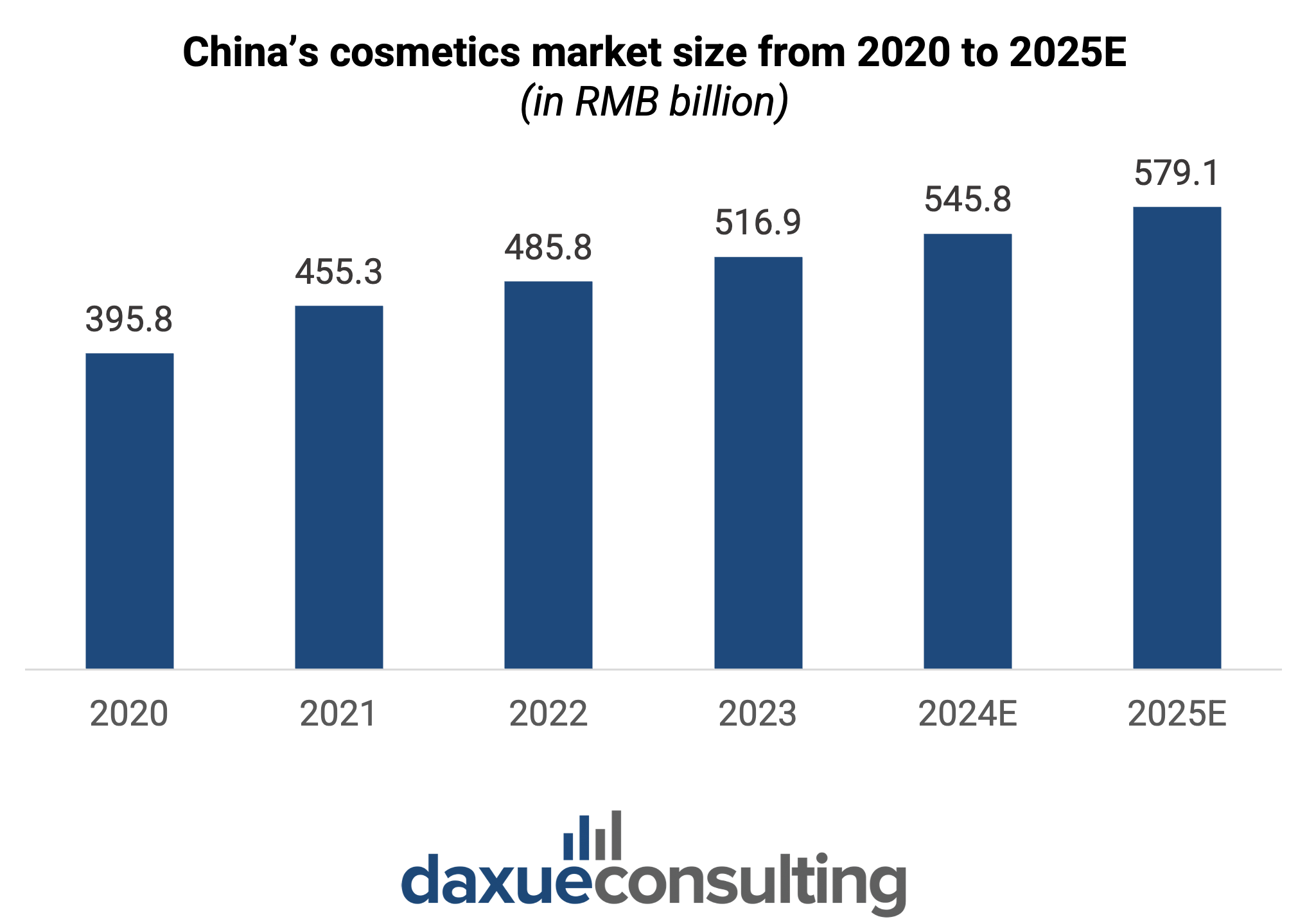
In 2023, China’s cosmetics market surpassed RMB 517 billion, recording a healthy 6.4% growth over 2022. With sustained interest in beauty, appearance enhancement and skin health, the market is projected to reach RMB 579 billion by 2025.
China’s cosmetics market, which comprises of skincare, makeup, and other products used to enhance or alter one’s appearance, is experiencing a fascinating shift in consumer preferences. There is strong focus on natural ingredients, premium products, and a growing support for Guochao. Moreover, there are emerging consumers like men and university students, prompting brands to innovate and meet diverse needs.
Download our report on Chinese beauty consumer pain points
Main consumers in China’s cosmetics market: young women from high tier cities
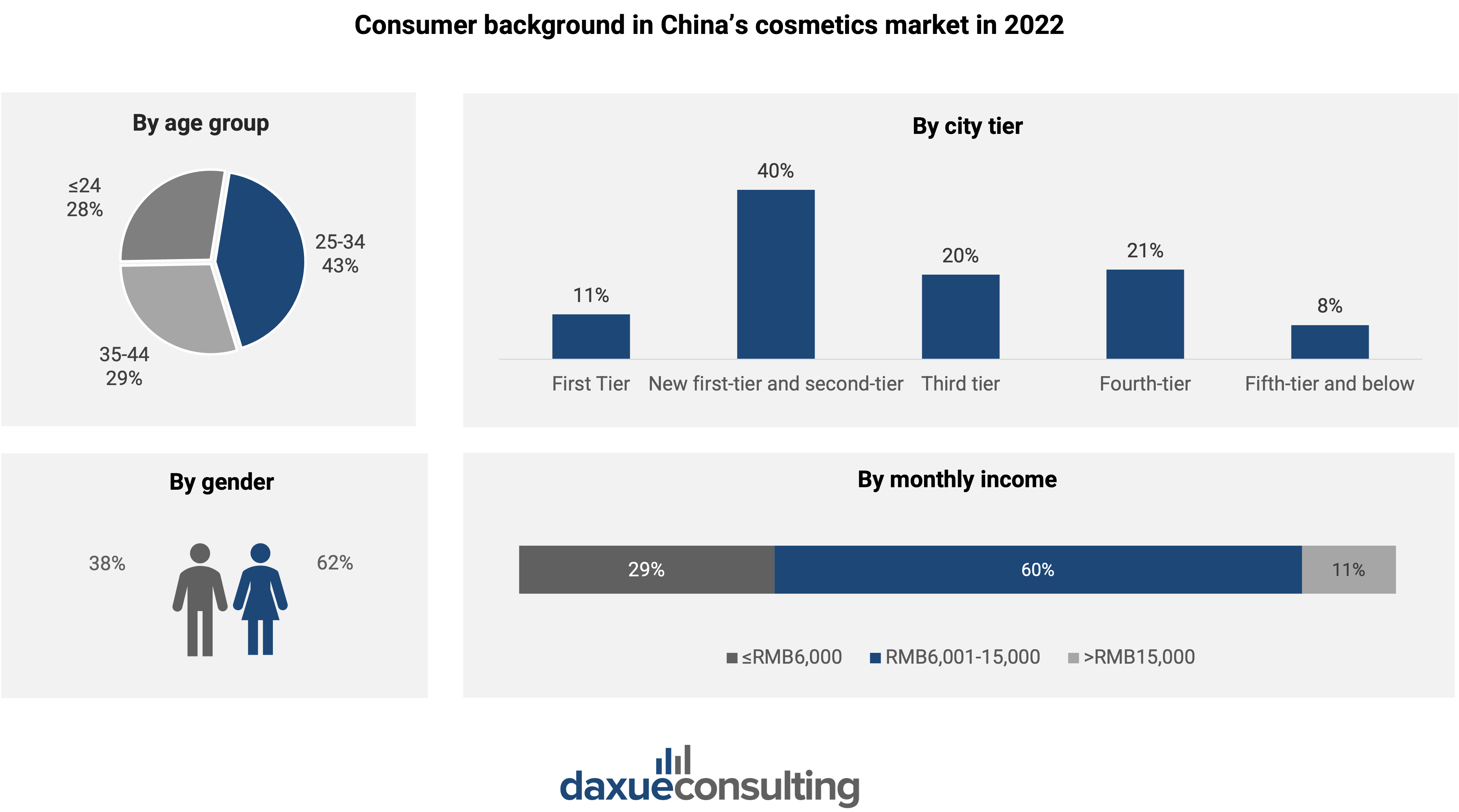
China’s beauty market is thriving, driven largely by female young Chinese adults who are in their mid-20s to early 30s. 43% of cosmetics consumers are 25 to 34 years old, which is moderately higher than 28% aged 24 or below and 29% aged 25 to 44. Women are the dominant consumers at 61.9%, but male consumers are more and more interested in skincare routines and premium cosmetics products. Many of these consumers reside in high tier cities. Over half of them were from first-tier, new first-tier, and second-tier cities, with three-fourth having a monthly income ranging from RMB 6,001 to 15,000.
University women: many beginners who suddenly makeup with little guidance
University women in China are a key demographic group that brands can appeal to as they have high interest in cosmetics and are willing to buy them. However, they struggle with issues that would typically be experienced at an earlier age in the West.
In China, many people start learning makeup at a later age compared to those in the West. Parents and schools are not very supportive of young people wearing makeup. This is because there are other priorities to focus on, like school, and makeup isn’t considered appropriate for young people. As a result, many Chinese people start learning how to wear makeup when they leave home for university.
Even though there are many products in the market, there is a need for those that suit makeup beginners. According to our social listening on pain points in China’s beauty market, young people in China find learning makeup too time consuming and difficult to learn, with other priorities like schoolwork and exercising.
Money is also an issue. Since beginners don’t know which product matches them well, they buy various products. However, they find the costs unjustifiable compared to the benefits.
Chinese workers: quick morning routines, short time for full makeup
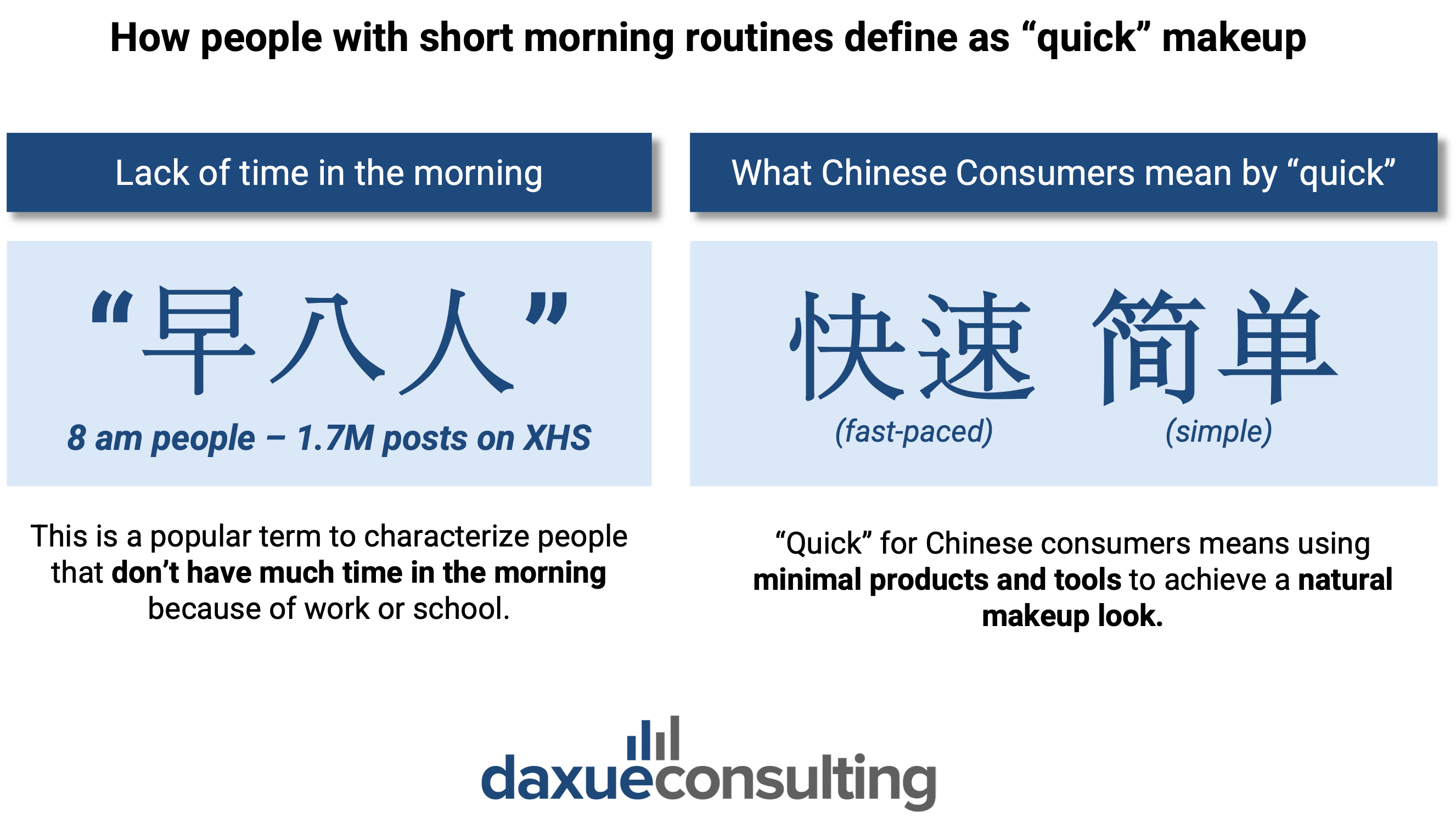
When joining the workforce, people often wear makeup. Chinese workers desire to look good throughout the day but lead demanding lives and prefer not to spend too much time or energy on their morning routines.
Young men: small yet promising consumers in beauty
Even though the male beauty market in China is just 2% of women’s, it is experiencing robust growth. It is particularly driven by young people born in the post-95s, live in top-tier cities, and have a high per capita beauty consumption.
At the same time, men’s needs have become more specific, oil control, sensitivity, barrier repair, shaving irritation, and acne management, pushing brands to upgrade both science and communication. Sensitive-skin topics, for example, have surged across platforms like RED, Douyin, and Weibo, reflecting stressed lifestyles and rising skin reactivity.
Global players such as L’Oréal, Shiseido, and Biotherm continue to dominate the higher end of the category due to their long-term dermatological R&D and clinical credibility. But domestic brands like Proya, Make Essense, and DearBoyFriend are scaling quickly by tapping into localized insights, male-oriented routines, and short-form content that resonates with young consumers.
Both multinational and domestic brands are increasingly targeting men who are not yet in the category. Rather than generic “male grooming education,” the focus is shifting toward structured, diagnostic-led routines, simplified product pathways, and behavior-based habit building (e.g., automated refills, reminders, one-click repurchase). As Douyin becomes a core conversion channel, leveraging problem-solution storytelling and non-beauty KOL/KOC creators, such as gym influencers, tech vloggers, and fragrance reviewers, is becoming essential to capture this emerging yet promising consumer base.
Key factors influencing Chinese consumers when buying makeup and skincare products
Chinese consumers are making more rational consumption choices. According to iResearch Inc, 67% of Chinese consumers make more planned and needs-based purchases and 64% make more rational choices. Consumers focus on discounts too, with 62% more attuned to such information.
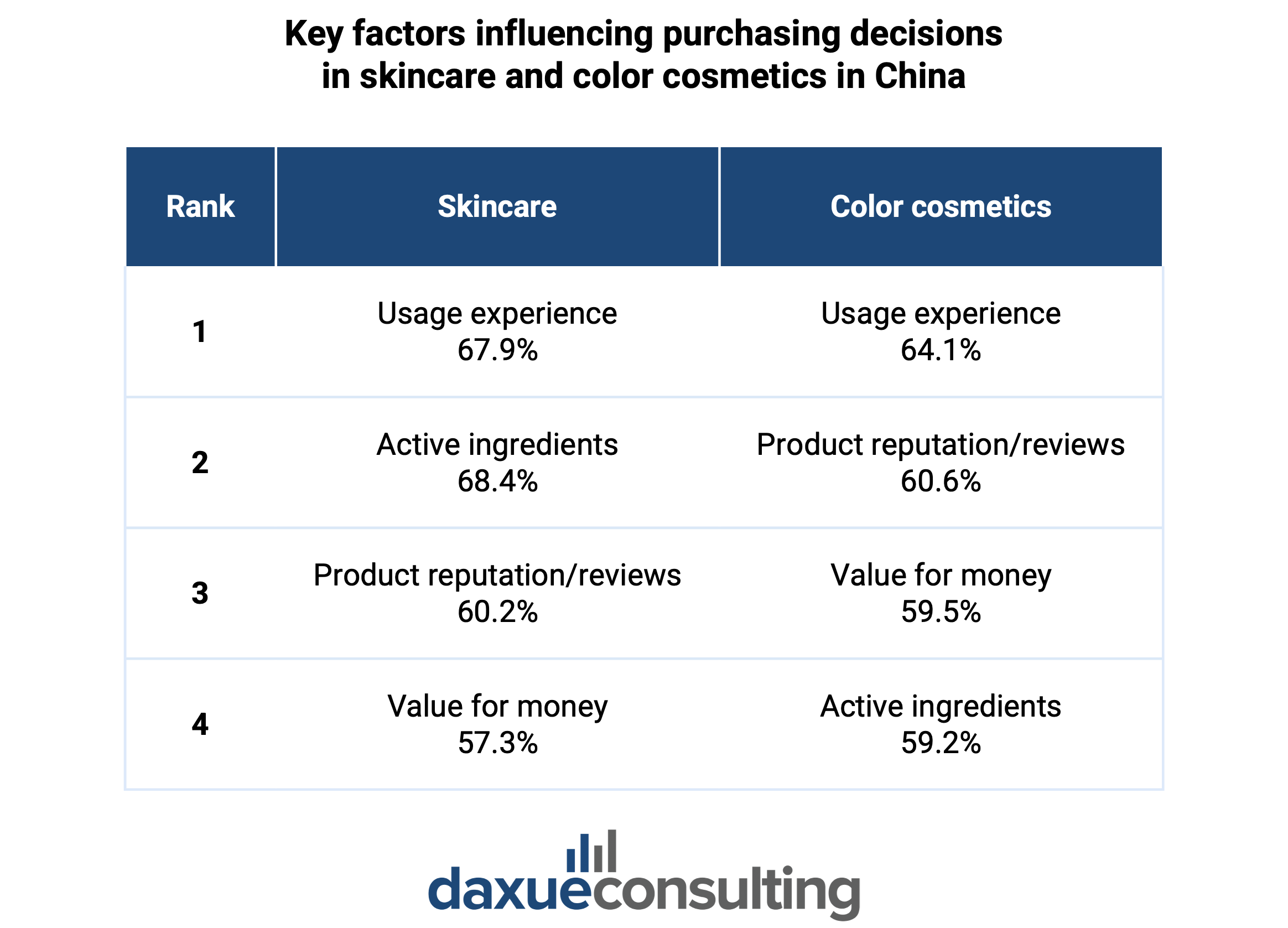
When purchasing makeup and skincare, consumers care most about usage experience – how they feel when using the product and how their skin reacts during and after use. However, the second most important factor is active ingredients for skincare and product reputation and reviews for makeup.
Download our China luxury market report
Growing focus on clean, sensitive-skin, and “clinical-natural” ingredients
Health-conscious beauty has only intensified in China post-pandemic. In 2025, “clean + safe + clinically proven” continues to dominate consumer decision-making. More than ever, Chinese consumers expect products to be both natural and backed by scientific validation, a shift from early clean beauty’s ingredient-avoidance mindset to a more sophisticated focus on skin compatibility, barrier health, and low-irritation formulas.
Sensitive skin has become one of the biggest category drivers. Across Xiaohongshu, Douyin, and Weibo, content related to skin irritation, redness, and barrier repair has surged, with sensitive-skin posts growing over 50% YoY. Topics once tied to “maskne” have broadened to include pollution, stress, and climate-induced sensitivity, making gentle, soothing ingredients (Centella Asiatica, beta-glucan, ceramides, oat) core to product development.
Consumer search behavior in 2025 shows rising demand for natural ingredients with functional claims, Manuka honey, Edelweiss, Tremella, and fermented botanicals, but always paired with clinical proof, transparent testing, and safety certifications. “Natural but effective” is the new baseline.
Millennials and Gen Z remain the core clean-beauty audience. Gen Z in particular shows strong preference for plant-based, low-irritation, fragrance-free formulas, while also being more ingredient-literate and wary of exaggerated “greenwashing.” These demographics actively cross-check formulas on Ingredient apps (成分党工具), follow dermatologists on Douyin, and rely on peer reviews on RED before purchasing.
While domestic brands have improved significantly in safety and transparency, foreign clean beauty brands still hold an edge in perceived trustworthiness, particularly in the premium tier, due to stronger regulatory reputations, longer R&D cycles, and clearer clinical frameworks. This trust gap continues to offer global brands opportunities, especially in sensitive-skin, baby-safe, and dermatologist-backed naturals.
Millennials and Gen Z driving China’s next wave of anti-aging growth
China’s anti-aging market surged to RMB 82 billion in 2021 and is estimated to reach RMB 153.2 billion by 2026, growing at a rate of 13.3% annually, as per Euromonitor data.
By 2025, Millennials and Gen Z have become the core engines of growth. Preventative routines now start as early as age 22–25, influenced by screen-driven aging concerns (blue light, long hours indoors), stress, and rising interest in skin longevity. Consumers increasingly seek high-performance actives such as retinol, peptides, bakuchiol, tranexamic acid, and encapsulated vitamin C, but expect them to be paired with barrier-supporting ingredients like ceramides, panthenol, and ectoin for tolerability.
Premium anti-aging demand is also rising sharply in China’s second- and third-tier cities, where disposable incomes and ingredient literacy have grown. Both foreign brands (L’Oréal, Estée Lauder, Shiseido) and domestic leaders (KANS, Winona, Proya’s Ruby line, Bloomage Biotech) are expanding clinically tested formulas, often combining biotech fermentation, HA complexes, or TCM-inspired botanicals to differentiate.
At the luxury end, “skin longevity” messaging, inspired by medical aesthetics, has entered mainstream retail, strengthening cross-over between skincare, dermocosmetics, and aesthetic clinics.
Social media and content ecosystems rewriting the anti-aging playbook
China’s anti-aging boom is inseparable from its digital landscape. In 2025, beauty discovery is shaped by a multi-platform loop where consumers move fluidly between Xiaohongshu, Douyin, WeChat Channels, and Bilibili before deciding what to buy.
The shift is notable in three ways:
- Skinfluencers > Celebrities.
Dermatologists, ingredient experts, and “efficacy bloggers” dominate anti-aging conversations. Their ingredient breakdowns, routine mapping, and before/after comparisons carry more trust than celebrity-led ads. - Douyin accelerates trial, but RED drives credibility.
Short-form evidence-led storytelling on Douyin fuels viral anti-aging launches, while Xiaohongshu anchors reputation through deep-dive reviews and long-term usage diaries. - Livestreaming evolves beyond drama-led selling.
While big livestreamers like Austin Li (“Lipstick King”) remain influential, 2025 has seen stronger traction from vertical KOLs in dermocosmetics, aesthetic medicine, and science-backed skincare. Austin Li still holds major sway, but sales impact now depends heavily on ingredient transparency, clinical proof, and user testimonials. His ability to sell thousands of SKUs instantly showcased livestreaming power in earlier years, but today the landscape has matured into a more evidence- and education-driven ecosystem.
As a result, brands in the anti-aging space must embrace medical-beauty inspired communication, transparent clinical data, and user-led proof to win in 2025’s highly literate and performance-driven market.
Cosmetics market in China: From social influence to the rise of men’s cosmetics
- China’s cosmetic market is growing, with a 6.4% increase in 2023. It is expected to reach RMB 579 billion by 2025.
- The main cosmetics consumers are young adults aged 25 to 35 years old and women, including university women and Chinese workers. More and more young men are interested in cosmetics.
- We conducted social listening on pain points in China’s beauty market. Our findings show that university women want to learn makeup but find it too difficult. Also, Chinese workers want to wear full makeup but have too little time in the morning.
- Chinese consumers prefer foreign brands over domestic ones in skincare and domestic brands over foreign ones in color cosmetics.
- Premium, anti-aging, and clean beauty products are growing in demand.
- Social media is crucial in engaging consumers and driving sales in China.
Contact us for in-depth beauty market research in China
The cosmetics market in China is a rapidly evolving landscape, driven by the rising demand for high-quality products, innovative ingredients, and sustainable practices. Daxue Consulting offers specialized market research in China, providing a comprehensive understanding of the preferences, behaviors, and emerging trends shaping the cosmetics market.
Our Chinese consumer insights empower businesses to tailor their products and marketing strategies to resonate with local tastes and expectations. We offer consulting services that help you stay ahead of industry developments and achieve sustainable growth. Connect with us today to discover how our expertise can support your brand’s success in China’s thriving cosmetics market.