
In China’s rapidly evolving beauty market, the conversation has shifted from “what ingredients are in your serum” to “how does your skincare make me feel?” For years, consumers, particularly millennials and Gen Z, were obsessed with ingredient efficacy: the precise percentage of niacinamide, the latest peptide innovation, the newest anti-aging molecule. Today, that obsession is giving way to a deeper desire: emotional connection and mental comfort, giving rise to what many call emotional skincare in China.
A 2023 report by Xinhua revealed that over 40% of young Chinese consumers now consider emotional value as a key factor in purchasing decisions, sometimes even ranking it above functional efficacy. This emerging trend has given rise to emotional skincare, also referred to as neurocosmetics, where the goal is no longer just to improve skin, but to improve mood, reduce stress, and foster a sense of wellbeing.
Yet not everyone is convinced. Skeptics argue that emotional skincare in China is a marketing ploy, a thin veneer applied when product efficacy is exhausted. Proponents counter that the field is grounded in neuroscience, psychodermatology, and measurable outcomes, marking the evolution of skincare from art to science.
The science behind emotional skincare
At the heart of emotional skincare lies the skin–brain axis, the biological dialogue between our nervous system and our largest sensory organ: the skin.
Stress manifests physically: anxiety and sleeplessness trigger the release of cortisol, a stress hormone that can accelerate inflammation, deplete collagen, weaken the skin barrier, and even contribute to premature aging. Conversely, neurotransmitters like β-endorphin, oxytocin, and melatonin can promote relaxation, boost skin resilience, and improve radiance.
The concept of neurocosmetics dates back to 2004, but recent advances have brought rigor and validation to the field. Japan’s POLA, for example, demonstrated that curiosity and positive mental states can improve skin elasticity through neurochemical pathways. Global research and market data indicate that emotional skincare is a growing economic force, with the neurocosmetics market projected to reach $3 billion by 2030.
These findings challenge the idea that skincare is purely cosmetic. Instead, the skin emerges as a sensorial organ capable of reflecting, and even modulating, emotional states.
From research to product
The most compelling proof of emotional skincare’s potential lies in how research is translated into consumer products. On the global stage, brands are pioneering ways to connect science and emotion. Sisley Neuraé in France, for instance, combines plant extracts with EEG-based testing to optimize neurotransmitter modulation, while Unilever explores how the skin microbiome can influence stress relief and mood enhancement. Clariant and Lucas Meyer are developing ingredients such as Rootness Mood+ and Neuroglow™, which are designed to simulate the positive effects of sunlight on both skin and mental wellbeing.
In China, domestic innovators are quickly following suit. Aesthesis, in collaboration with Jinan University, co-published the country’s first Neurocosmetics White Paper, using stress biomarkers like α-amylase and cortisol to validate the efficacy of its products. EVE LOM, under the Yatsen Group, has integrated its proprietary NeuroRelief™ technology with EEG monitoring and spearheaded China’s first Emotional Skincare Development & Evaluation Guidelines. Yulongchu, positioned around emotional sensitivity, emphasizes comfort and mental relief in its formulations. Together, these examples illustrate a profound shift in the industry’s value proposition: emotional efficacy is no longer a marketing afterthought but is becoming a core selling point, on par with traditional functional benefits such as anti-aging or brightening.
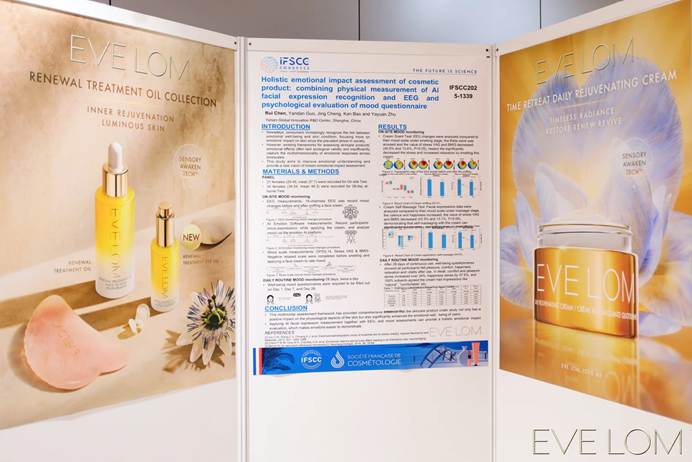
What emerges is a shift in the industry’s value proposition: emotional efficacy is no longer a marketing afterthought; it is becoming a core selling point, akin to anti-aging or brightening effects.
Beyond creams: The rise of multi-sensory skincare
Emotional skincare extends well beyond serums and masks, encompassing fragrance, texture, and ritual as integral elements of the consumer experience. YSL’s “Scent-Sation” stores, for example, allow visitors to measure brainwave responses to fragrances, recommending scents that align with their current mood. Similarly, Givaudan leverages AI to map scent, color, and emotion, creating highly personalized olfactory experiences. Even the way a product is applied with its temperature, texture, pressure, and packaging aesthetics, which serves as a subtle psychological cue, signaling relaxation and wellbeing.

This multisensory approach aligns closely with broader wellness trends. Meditation apps, sleep masks, and aromatherapy now complement topical skincare, transforming emotional skincare into a holistic beauty ecosystem. The convergence of ritual, sensorial design, and scientific validation is redefining what beauty can achieve: not just visible results, but measurable emotional benefits.
Market challenges in China
Despite the promise, emotional skincare in China faces significant hurdles. Regulatory frameworks remain unclear, as emotional claims are not officially recognized as a functional category, complicating marketing strategies. Consumer education is still nascent; most equate emotional skincare with fragrance therapy and have limited understanding of cortisol, neurochemistry, or psychodermatology. The supply chain is also fragmented, with few companies capable of integrating ingredients, neuroscience research, and sensory R&D into scalable solutions. Skepticism remains high, with some questioning whether skincare can genuinely modulate emotions. The recent closure of UK brand Faace in 2024 underscores this challenge, highlighting the gap between concept and sustainable business execution.
Looking ahead: Personalization and integration
The future of emotional skincare points toward highly personalized, integrated solutions. Emerging technologies in cortisol monitoring, sleep tracking, and emotion analysis could enable the creation of individualized formulas that respond to both internal and external factors. Skincare may increasingly integrate with supplements, nutrition, and lifestyle interventions, forming an inside-outside approach. Digital wellness ecosystems, combining products, rituals, and apps, could deliver seamless emotional experiences tailored to each consumer.
While emotion is not equivalent to function, when anchored in scientific validation it can amplify brand loyalty, deepen engagement, and provide measurable wellbeing outcomes. The next frontier in beauty is no longer merely about looking better. It is about feeling better, with evidence to support it.
Beyond skin deep: Emotional skincare in China as the next growth frontier
Emotional skincare represents a paradigm shift in China’s beauty market. It bridges science and sentiment, addressing both skin health and psychological wellbeing. For brands willing to invest in research, education, and multi-sensory experiences, emotional resonance may emerge as the next key growth driver. In a market fatigued by formulas, skincare that nurtures the mind as well as the skin could redefine the meaning of beauty.